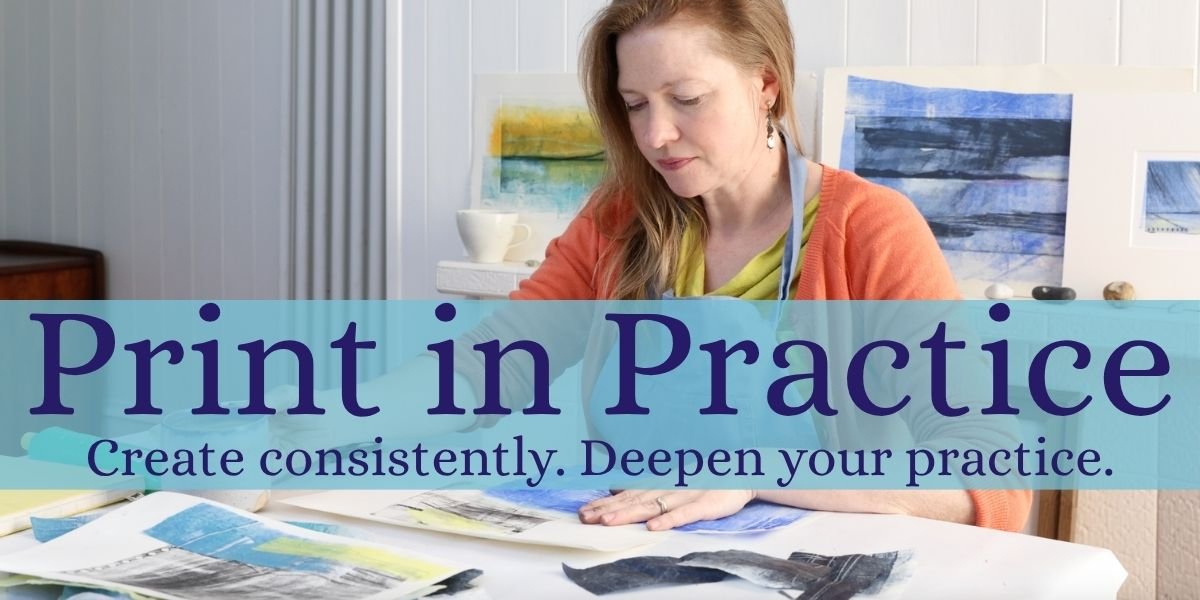
From making prints to developing a print practice that feels like you.
You’ve learned how to make prints.
You’ve made some prints you love. You’ve experimented, played, tried things that worked brilliantly and things that really didn’t.
And now you’ve reached the interesting bit.
How do you turn all that making into a creative practice that actually goes somewhere?
How do you know what to do next when you’ve got a pile of prints, a head full of ideas and a precious bit of time to make?
How do you develop an idea into a series?
How do you know when a print needs something more — and when to leave it alone?
And how do you turn those prints into finished artwork you’re genuinely excited to show?
Print in Practice is for the bit that comes next.
A self-paced course for artists and printmakers who already have some printmaking experience and want to bring more intention, confidence and direction to their practice — without losing the freedom and experimentation that makes printmaking so much fun.
Sound familiar?
You’ve finally got some time in your making space, and…
- You’re looking through your pile of prints, knowing some of them could be great — but you’re paralysed by the fear of ruining what you already have.
- You’ve got plenty of collage fodder and materials, but when you finally have time to make, you can’t think what to do.
- You’ve fallen in love with a subject, landscape, object or mark and could make 100 different prints about it — but you don’t know where to begin.
- You’re constantly wondering, Should I do this, or that? and wishing you could just make a decision and get on with it.
- You’ve made some good, even great, prints — but you’re not sure how to turn them into a consistent body of work you love.
- And now you’ve got artwork you want to show the world, you’re faced with a whole new set of questions: Which pieces should you show? How do you sign them? Should you frame them? How do you photograph them? And do you really have to spend a fortune on frames?
You don’t need more techniques thrown at you.
You need a way to use what you already know.
That’s what we’ll work on in Print in Practice.

Imagine:
Having a library of marks that really feel like you to turn to whenever you want to make.
Knowing how to start a project with intention — without planning all the spontaneity out of it.

Understanding which few decisions could elevate a piece of artwork, and which things are better left alone.
Trusting yourself to take creative risks without constantly second-guessing yourself.
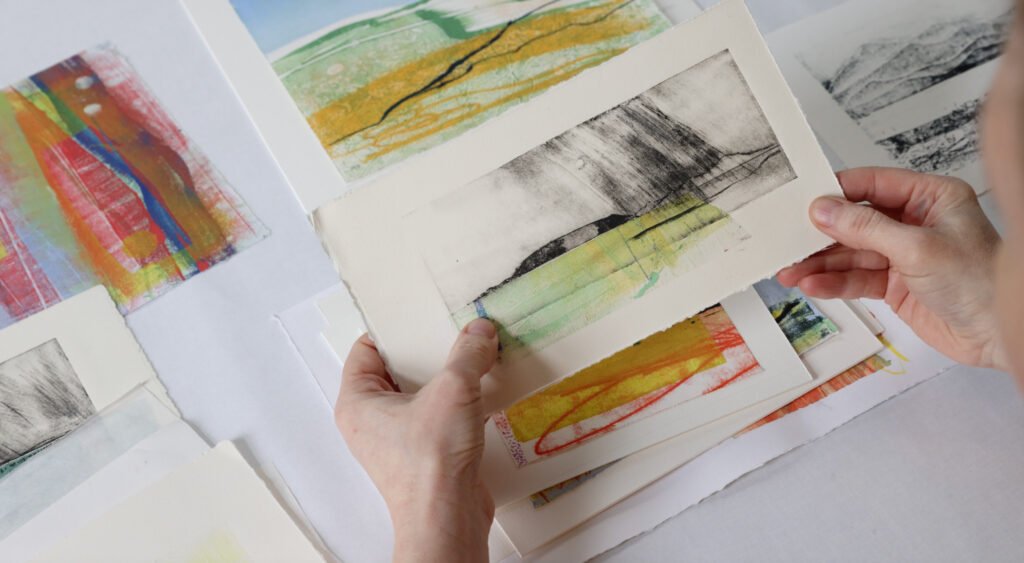
Being able to look at a pile of prints and see possibilities rather than failures.
Starting to see connections between individual prints and recognising when you’ve got the beginnings of a series.
Having ideas for what to do with the prints that don’t work quite as planned — from artist books and textiles to mixed-media work.

And eventually…
producing a body of work that could only have been made by you.
You’ll also know how to choose, photograph, sign, mount and frame your work so that you’re confident putting it out into the world.
And if you want to apply for open calls, submit to galleries or sell your work, you’ll know how to approach that too.
In other words: You already know how to print. Let’s explore what you can do with it.
Your journey through Print in Practice
Module 1 — Print as Practice
Build a creative practice you actually want to return to.
We’ll look at the practices that are worth doing regularly to hone your skills and build confidence.
You’ll learn how to start a project, what to plan and what to leave to serendipity as you print.
We’ll also look at choosing the right materials for your project — including which supplies are worth spending a little more on and which aren’t.
Module 2 — Printing a Series
Stop making one-offs. Start following an idea.
Making multiple iterations of a print gives you something incredibly valuable: options.
We’ll explore the variables you can change as you work through a series — colour, texture, marks, composition and more — and how to use those variables deliberately while still leaving room for happy accidents.
If you have access to a printing press, I’ll also show you how to set one up.
Module 3 — How Not to Ruin Your Prints!
Make creative decisions with more confidence.
You’ve made something good.
Now what? Do you leave it alone? Add something? Crop it? Print over it? Make another version?
We’ll look at ways to elevate your artwork without taking unnecessary risks, along with simple things you can try that almost always make a piece stronger.
The aim isn’t to eliminate risk. It’s to help you feel confident enough to take it.
Module 4 — What can I do with the prints that don’t work out?
Turn your “failures” into the beginnings of something new.
Not every print is going to work. That’s part of printmaking.
But a print that doesn’t work as a finished piece can be fantastic raw material.
I’ll show you three different artist book projects:
- a simple ribbon-bound book
- a concertina book
- a slit-fold book
We’ll also explore how I use prints in mixed-media work — deciding how to start, what to add and how to bring a piece to completion.
And we’ll look at using print with textiles, including stitch as drawing, glue and colour.
You might even start to love your mistakes.
Module 5 — Presenting & Displaying Your Work
You’ve made the work. Now let’s get it out into the world.
Choosing your strongest work can be surprisingly difficult.
I’ll share my 3 D’s approach for looking at your work afresh, then we’ll cover:
- photographing your artwork
- flattening and signing
- cropping and mounting
- choosing between glazed and non-glazed frames
- alternatives to traditional framing
- displaying work without bulky or expensive frames
We’ll consider solutions for different budgets and different types of exhibition.
So when an opportunity comes along — whether that’s an open call, gallery submission or selling opportunity — you’ll feel ready.
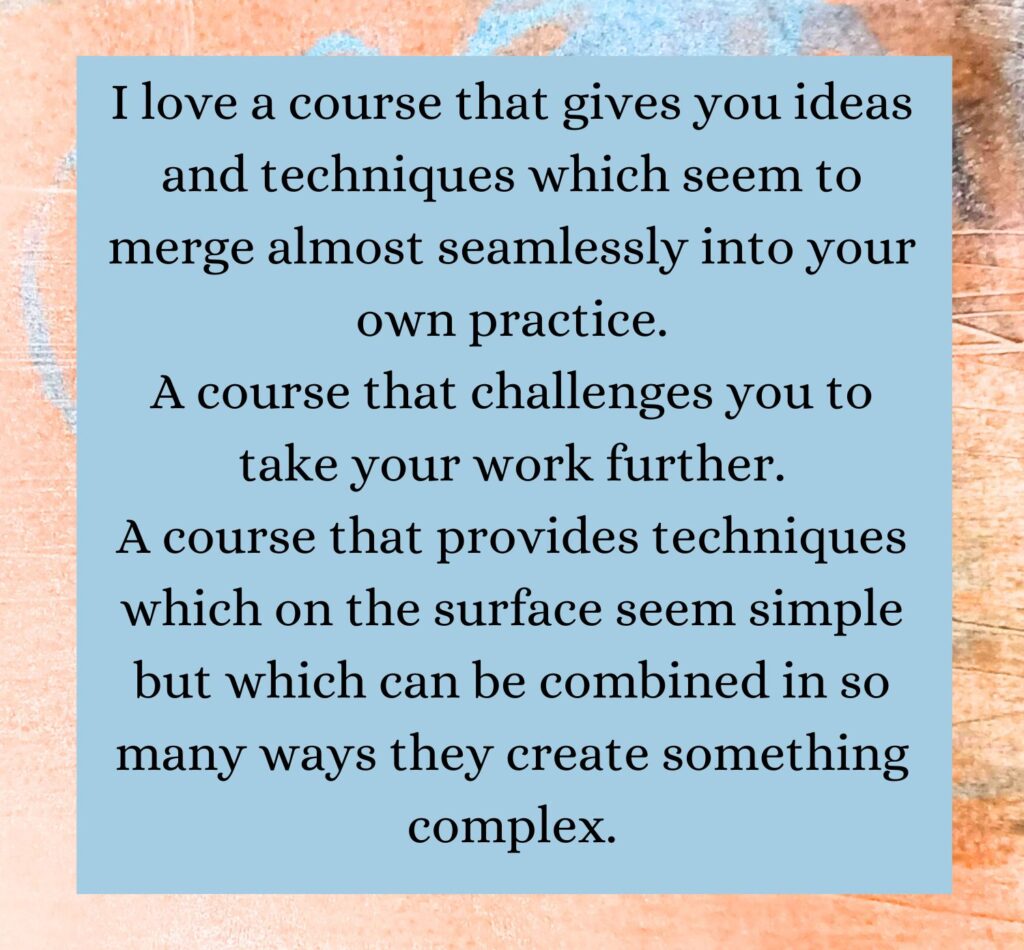
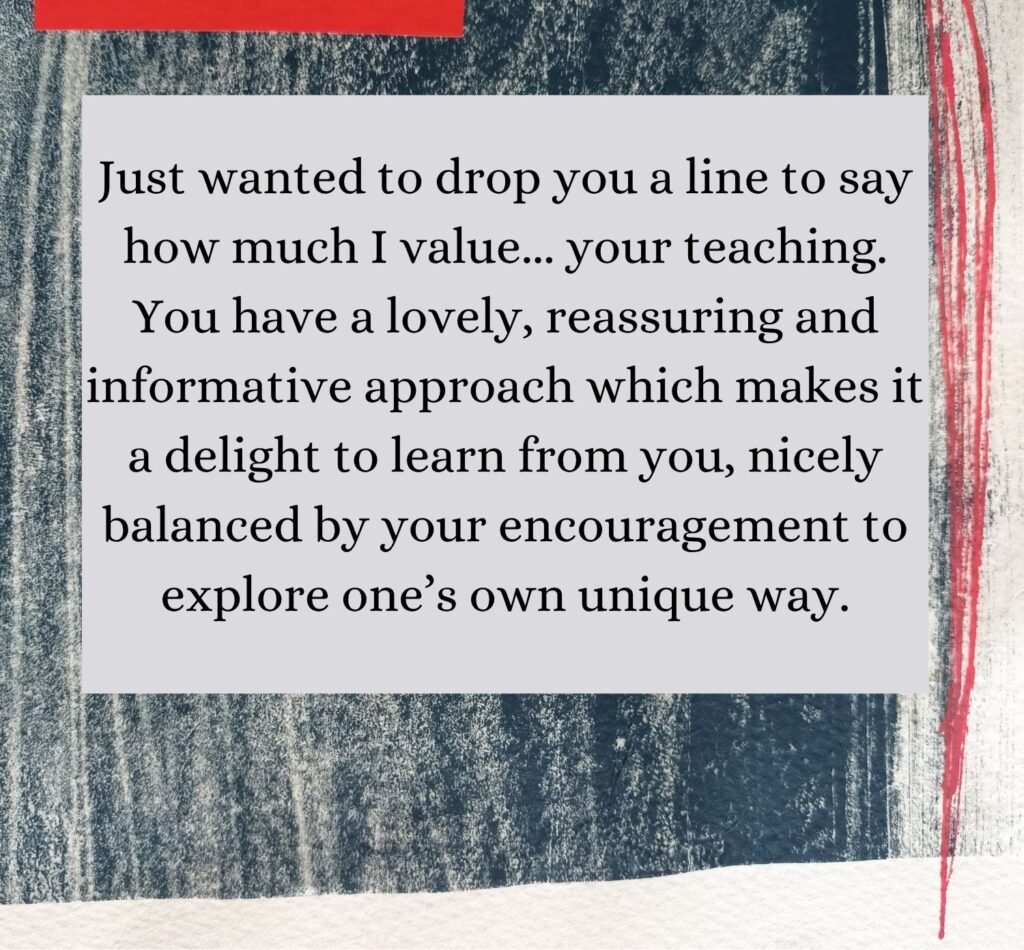
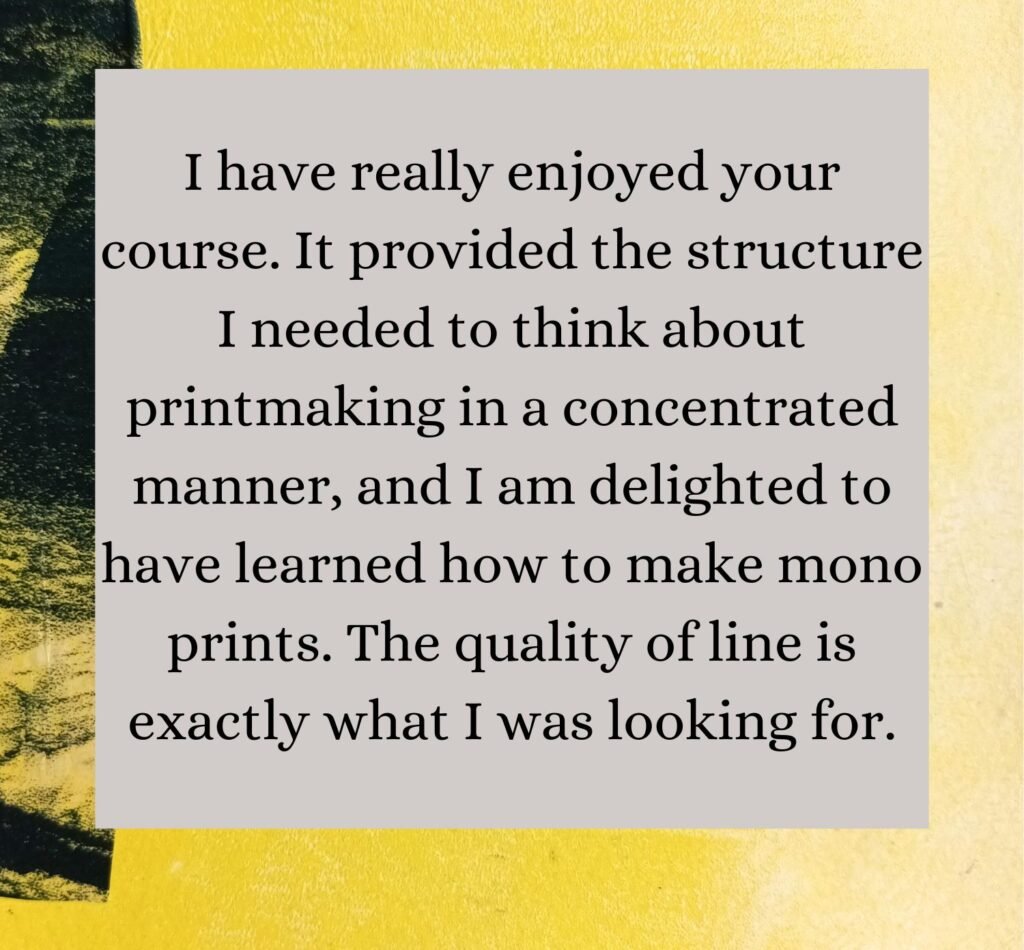
Take a look at how I’ve helped other makers, printmakers and artists:

What will you have by the end?
Print in Practice isn’t about producing a perfect portfolio by the end of a course.
It’s about developing a way of working that you can keep using long afterwards.
By the end, you’ll:
- Have a regular print practice that improves your mark-making and composition skills over time.
- Know how to start a project or series and which materials to reach for.
- Understand how much to plan and which variables you can play with when making multiples or series.
- Feel much more confident making decisions about where your work should go next.
- Have a collection of things to try when you feel a print needs taking further.
- Have ideas for using print in books, textiles, mixed media and other creative projects.
- Understand which display methods work best for you, your artwork and your budget.
- Feel confident presenting your work and applying for opportunities.
Most importantly: You’ll have a better understanding of your own creative practice.
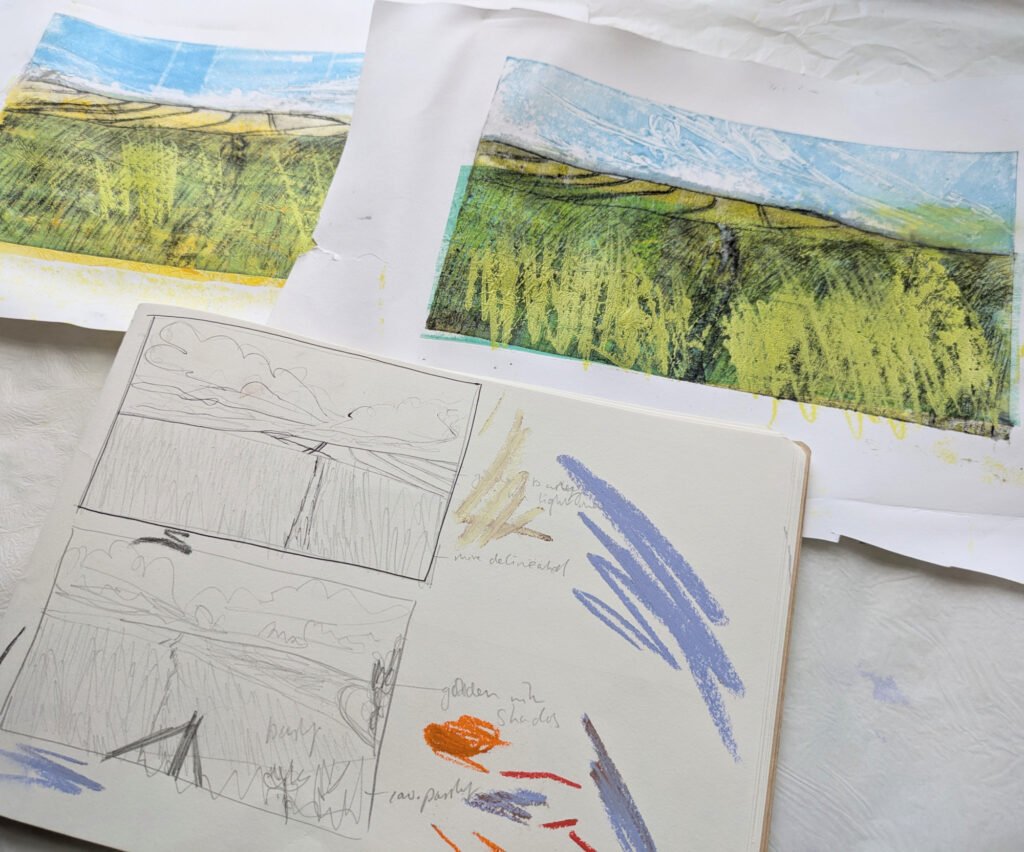
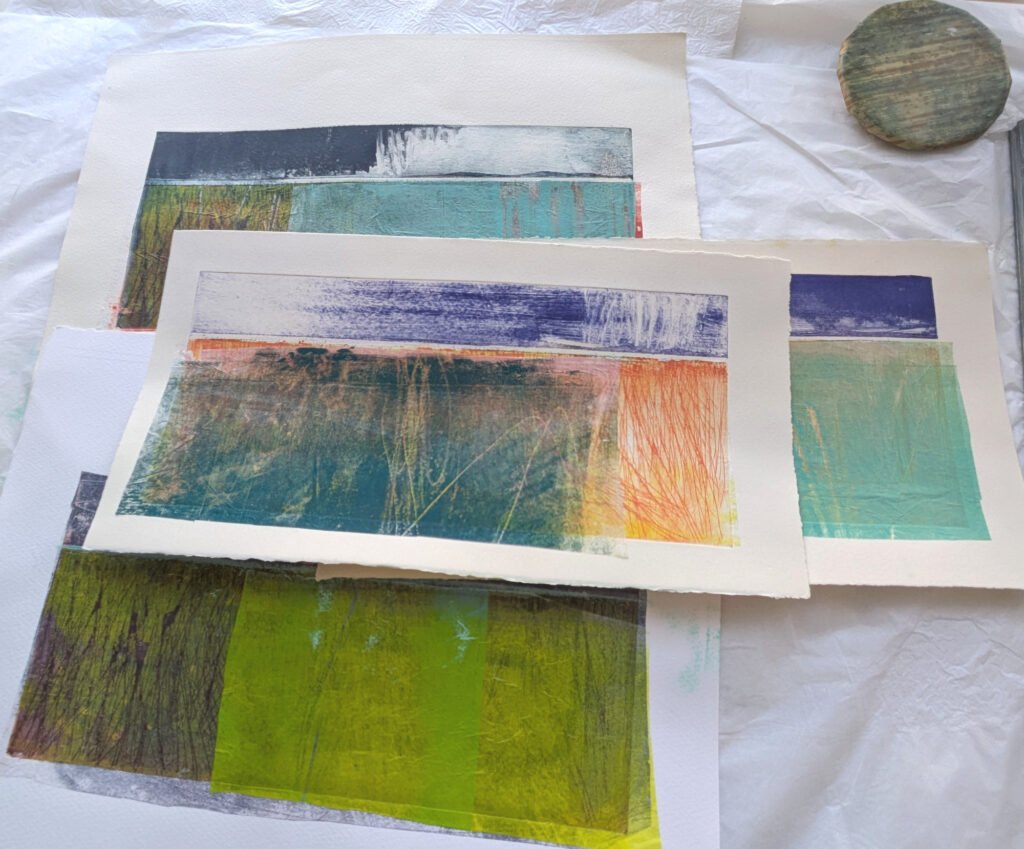
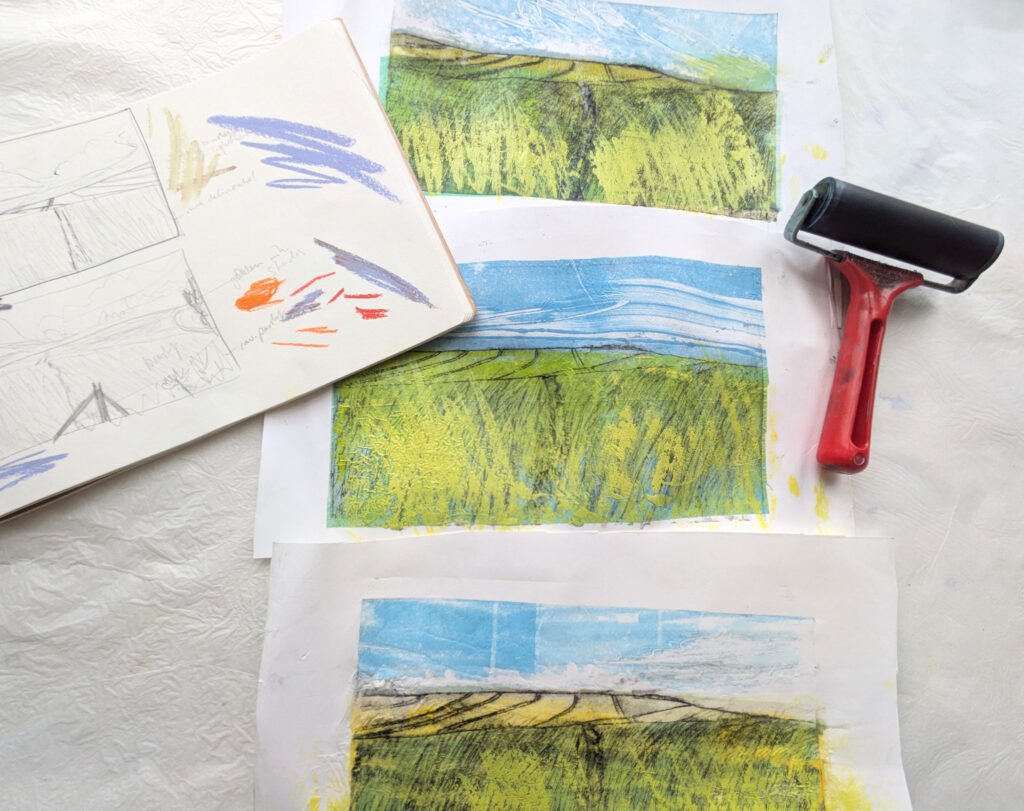
Who is Print in Practice for?
This course is for you if:
You’ve printed before. Maybe you’re still printing regularly. Maybe you’ve had a break and want to find your way back in.
You have some printmaking knowledge, but want more direction.
You’re looking for a way to move beyond making individual prints and start developing ideas, projects and series.
You love experimenting, but sometimes the sheer number of possibilities leaves you wondering what to do next.
You have a pile of prints. Some are brilliant. Some aren’t. Some might become something else entirely.
You want to make artwork, not just prints.
You’re interested in where print can take you — into books, textiles, mixed media or a body of work that feels uniquely yours.
You can work by hand or with a printing press.
And if you’re a Gelli plate printer, much of the teaching will be relevant too — although I won’t be teaching specific Gelli plate techniques or materials.
Who isn’t it for?
If you’ve never printed before and you’re looking for step-by-step instruction in printmaking techniques, this isn’t the course for you.
I’d recommend starting with Hand Printing Happiness instead.
If you’re already comfortable making prints and you’re ready to explore what happens when you start developing them into a practice, you’re in the right place.
So, how does it all work?
When you enrol you’ll receive an email asking you to login to Kajabi, the platform the course is hosted on, and you’ll have access to all the modules straight away.
I suggest working through them in order, as they’re designed to take you from regular practice, through intentional print projects to presenting and displaying your work.
You’ll also have access to my print community on Kajabi – Home Print Club – where there’ll be a dedicated ‘Print in Practice’ forum/thread for you to share work, ideas or ask questions.
And you’ll have lifetime access to the course.*
*Lifetime access means that, as long as Ruth Ander Prints and the course platform exist, you’ll have access to the course.
Your course includes:
5 in-depth modules
Self-paced access
Lifetime access
Home Print Club community
A materials list and suggested stockists
Take a look at the materials list and stockists below:
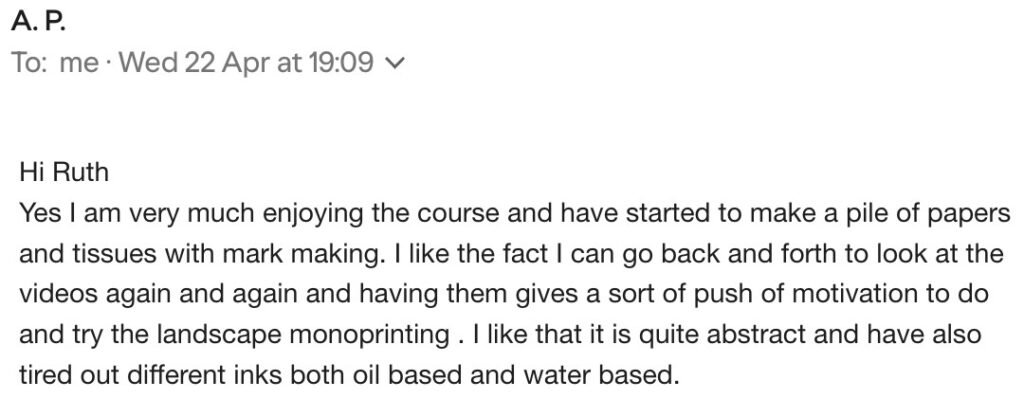
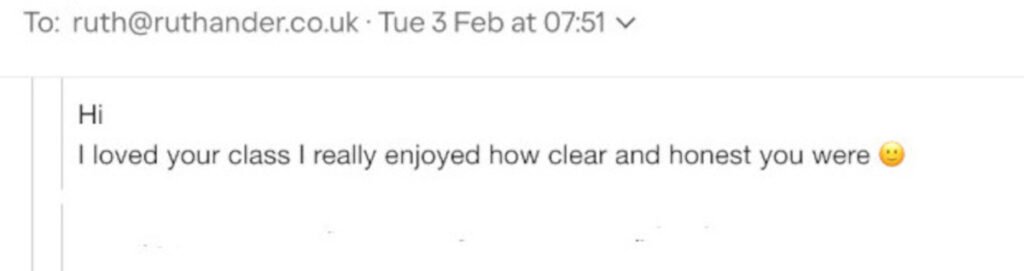
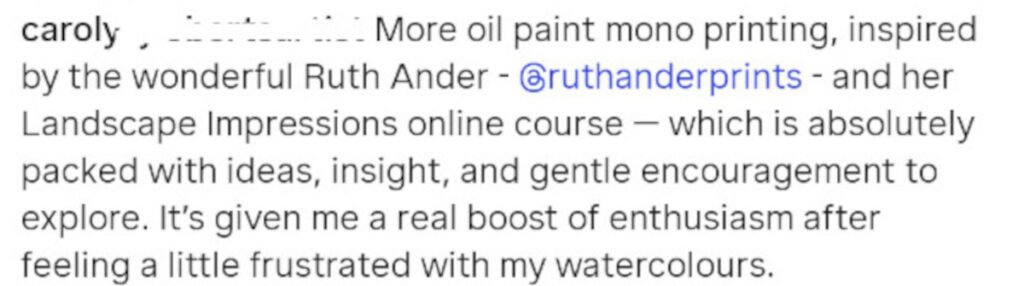
Many students have loved my spontaneous approach to printmaking:
FAQs
Do I need printmaking experience?
Can’t I just watch your YouTube videos?
Will I need to keep up?
How long will I have access to the videos?
Will there be a way to share work and interact with other participants?
Will I get one to one feedback on my work?
I do Gelli plate printing – will this be relevant?
I’ve bought one of your instant access/self-paced courses before- will this cover the same ground?
Do I need to be able to draw or paint?
Do you provide refunds?
Do I need all the supplies?
What happens after I enrol?

Who’s your tutor?
I’m an artist with a BA (Hons) in Illustration, over 20 years of home hand-printing experience as well as extensive print studio experience.
I’ve always loved the marks and textures of printmaking, (the smell of ink gives me a little thrill), and I now teach others via my free resources and online courses.
I’m a firm believer in DIY and the low-tech, and I’ve guided 100’s of students to push their boundaries, find creative flow, and create art that they love.
Ready to make more of your prints?
You don’t need more ideas. You don’t need to master another 20 printmaking techniques.
You need some time, some space, and a little guidance to explore what you’ve already got — and discover where it could take you.
Turn your experiments into artwork. Turn individual prints into ideas.
Turn ideas into a practice that’s uniquely yours.